



















This glossary explains the most important heating and plumbing terms in one or two sentences. It comes from AKKAYA Bauelemente GmbH, a specialist dealer for heating, sanitary and building supplies in Hagen, Germany. Each term links to the guide or category in which we cover the topic in detail. Information about our own products comes from our product data.
Jump to: A · B · C · D · E · F · H · I · M · O · P · R · S · T · U · V · W
A
Actuator (NC and NO)
An actuator opens and closes the valve of a heating circuit on the heating circuit manifold. NC means closed without power, NO open without power; the two versions are not freely interchangeable, even if the thread is the same. Read more: Underfloor heating actuator: NC, NO and the right replacement.
Alcove door
An alcove door closes a shower that is already enclosed by walls on three sides. The width of the alcove is decisive for the choice. Read more: Alcove shower door: measuring the width and choosing a model.
Angle valve
The angle valve connects the water pipe coming out of the wall to a tap or appliance and shuts it off. For the size, two connections count separately: ½ inch at the wall and ⅜ inch to the tap are common, other versions are possible. Read more: Determining the angle valve size: dimensions, thread and connection.
B
Ball valve
A ball valve shuts off with a quarter turn: if the lever points along the pipe, it is open; if it is across, it is closed. It is built only for fully open or fully closed, not for throttling. Read more: Ball valve or valve? Shut-off valves for heating and drinking water.
Bath screen
A bath screen is a glass panel on the edge of the bathtub that keeps splash water in when you shower in the tub. It comes as a folding screen, fixed, with a sliding door or as a corner screen. Read more: Glass bath screens: sizes and designs.
Bathroom radiator, towel radiator, towel warmer
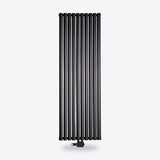
Bathroom radiator is the general term for radiators in the bathroom; towel radiator emphasises the rails for hanging towels and usually means the same unit. Towel warmer is often used for smaller, frequently electric units that mainly dry towels and heat the room less. Read more: Towel radiator, bathroom radiator, towel warmer: what is what?
Bleeding a radiator
If a radiator stays cold at the top while the bottom warms up, there is usually air inside. When bleeding, the air is released at the bleed valve, usually with a square key. Read more: Bleeding a radiator: step by step.
C
Compact radiator
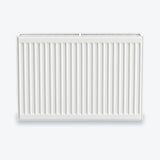
In the trade, compact radiator usually means a panel radiator with side connection: the thermostatic valve sits on the outside of one of the side connections. The word therefore says something mainly about the connection, not about the number of panels. Read more: Radiator types: flat, valve and compact radiators.
Compression fitting
In a compression fitting, the union nut, body and compression ring press the pipe tight when tightened. Unlike a press fitting, it can be undone again. Read more: Press fitting or compression fitting: what suits your composite pipe?
Concealed mixer: rough-in body and trim set
With a concealed mixer, the rough-in body sits in the wall and is part of the installation; the trim set is the visible control. A new trim set only fits a rough-in body intended for it, which is why the rough-in body is identified first. Read more: Choosing a concealed mixer: which rough-in body fits?
D
Depth of a radiator
The depth is the depth of the radiator itself, from front to back, without bracket and valve. How far it projects from the wall only follows once the distance set by the wall bracket is added. Our valve radiators measure 104.3 mm for type 22 and 160.3 mm for type 33, regardless of height and length. Read more: Radiator depth: type 11, 22 and 33 in mm.
Designer radiator
Designer radiator describes the shape, not the room: flat panels or special colours, in the bathroom as well as in living spaces. Read more: Designer radiators.
E
Expansion vessel
Heating water expands when it heats up. The expansion vessel absorbs this change in volume and keeps the pressure in the system largely constant; in today's common diaphragm expansion vessels, a rubber diaphragm separates the water from a gas cushion. Read more: Heating expansion vessel: purpose, pre-charge pressure and replacement.
F
Female thread (IG) and male thread (AG)
The female thread is inside the opening of a component, the male thread on the outside of a connection spigot. For fittings, each connection is stated separately, for example “½ inch IG to ½ inch AG”. Read more: Brass threaded fittings: female, male and the right shape.
Flat cover panel
A flat cover panel is a smooth cover made of white powder-coated steel that is placed in front of the profiled front of a radiator and gives it the look of a flat-front radiator. Ours holds with clips and magnets, without drilling or gluing. Read more: Flat cover panel for radiators: sizes, fitting without drilling.
Floor-level shower
In a floor-level shower, the glass enclosure stands directly on the tiled floor, without a shower tray; the water drains through a shower channel or a floor drain. Slope, drain and waterproofing are planned as part of building the floor. Read more: Shower enclosure without a shower tray: floor-level installation or a tray?
Flow and return
The flow brings the warm heating water from the heating system to the radiator; the return carries the cooled water back. Which pipe is flow and which is return is checked by the contractor before installation. Read more: Connecting a radiator at the bottom: flow, return, valve block.
Flow meter
A flow meter sits on the manifold of an underfloor heating system for each heating circuit and shows how much water flows through the circuit; depending on the design, the flow is also set there. Whether our heating circuit manifold has flow meters is currently not confirmed; we clarify this before you order. Read more: Underfloor heating: adjusting the manifold.
H
Heat output at 75/65/20 and 55/45/20
The three numbers give the flow, return and room temperature in °C at which a radiator's output is stated; the standard output according to DIN EN 442 applies to 75/65/20. 55/45/20 describes cooler operation, as many systems run today, for example with a heat pump. Read more: Radiator output table type 22 and type 33.
Heat pump and flow temperature
The flow temperature is the temperature at which the heating water flows to the radiators. A heat pump works more economically the lower it is; a radiator, however, gives off less heat at a lower flow temperature and must be large enough for that. Read more: Low-temperature radiators for heat pumps.
Heating circuit manifold
All heating circuits of an underfloor heating system meet at the heating circuit manifold; each circuit has its own outlet. The number of outlets follows from the design, not from the number of rooms, because one large room can have several circuits. Read more: Heating circuit manifold sizes: outlets and matching manifold cabinet.
High-efficiency pump
A high-efficiency pump is a particularly economical circulation pump that regulates its speed itself according to demand; since August 2015, new glandless circulation pumps in the EU may have an energy efficiency index (EEI) of at most 0.23. For radiators, manufacturers usually recommend proportional pressure control, for underfloor heating constant pressure. Read more: Replacing the heating pump: type plate, dimensions and high-efficiency pump.
Hub centre distance
The hub centre distance is the centre-to-centre distance between the side connections of a radiator. On our valve radiators it is 55 mm less than the overall height, so 545 mm at a height of 60 cm. Read more: Replacing a radiator: measuring height, length and hub centre distance.
Hydraulic balancing
In hydraulic balancing, a heating contractor adjusts the system so that each radiator gets the amount of water its room needs. To do this, the contractor determines the heat demand of each room, sets the valves to calculated values and adjusts the pump and heating curve. Read more: Hydraulic balancing: signs, procedure, valves and obligation.
I
Inch thread
The inch size of pipe threads is a name, not a measurement on the thread: it comes from the inside diameter of old steel pipes. That is why the male thread of a ½ inch fitting measures about 21 mm. Read more: Inch threads in millimetres: why 1/2 inch measures about 21 mm.
M
Manifold cabinet: surface-mounted and flush-mounted
The surface-mounted manifold cabinet is placed in front of the wall, the flush-mounted one in a wall recess; its installation depth must suit the wall. The size of the cabinet depends on the heating circuit manifold and therefore on the number of heating circuits. Read more: Heating circuit manifold sizes: outlets and matching manifold cabinet.
Middle connection
On a bathroom radiator, middle connection means pipe connections in the middle area of the radiator, side connection means connections at the side. Which arrangement a model has is stated in its documents; when replacing, the position of the existing pipes counts. Read more: Bathroom radiator: middle connection or side connection?
Multilayer composite pipe
Multilayer composite pipe combines a metal layer, often aluminium, with plastic layers. The outer diameter is stated first, then the wall thickness: 16 × 2 has an inside diameter of 12 mm. Read more: Multilayer composite pipe: inner diameter, insulation thickness and drinking water.
O
Open on one side (bathroom radiator)
“Open on one side” describes free access to the towel rails from one side on a bathroom radiator. It has nothing to do with the connection: a radiator open on one side does not automatically have a side connection. Read more: Bathroom radiator: middle connection or side connection?
P
Panel radiator and flat radiator
A panel radiator consists of flat steel panels through which the heating water flows; because it sits flat on the wall, it is also called a flat radiator. In German, “Radiator” is the everyday word for almost any heater on the wall and used to mean mainly sectional radiators made of cast iron or steel. Read more: Flat radiator, panel radiator, radiator: what is what?
Pre-charge pressure (expansion vessel)
The pre-charge pressure is the pressure of the gas cushion in the expansion vessel, measured without water pressure and stated in bar. If it is too low, the vessel already takes in a lot of water during filling and there is no room left when heating up; if it is too high, the water reserve is missing when cold and the pressure drops on cooling. Read more: Calculating an expansion vessel: size and pre-charge pressure table.
Presetting (thermostatic valve)
With presetting, a presettable thermostatic valve limits the maximum flow through the radiator. In hydraulic balancing, each valve gets a calculated value, which is read off the valve manufacturer's setting diagram. Read more: Presetting thermostatic valves: values for hydraulic balancing.
Press fitting
A press fitting is pushed onto the pipe and permanently pressed with a pressing tool; the joint cannot be undone afterwards. For multilayer composite pipe there are also push-fit fittings, compression fittings and threaded fittings. Read more: What is a press fitting? Fittings for composite pipe.
Press profile
A press fitting only stays permanently tight if the press jaw matches the profile of the fitting. The profile is marked with letter codes such as TH, H, U, V or M on jaws and in data sheets. Read more: Press profile TH, H, U, V or M: which press jaw fits?
R
Room thermostat
In underfloor heating, the room thermostat measures the temperature in the room and switches the actuator on the heating circuit manifold. The actuator then opens or closes the valve of the heating circuit in that room. Read more: Room thermostat for underfloor heating and the matching actuator.
S
Shower channel
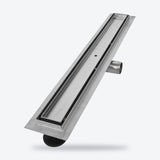
A shower channel is a long, narrow drain in the floor of a floor-level shower, for example along a wall. A point drain, by contrast, collects the water at one spot. Read more: Choosing a shower channel: length, cover and drain.
Shower door: sliding, pivot, hinged
A sliding door needs no space in front of the shower to swing open. A pivot door opens inwards and outwards, a hinged door swings on hinges, usually outwards. Read more: Sliding, pivot or hinged door: which shower door fits?
Shower tray
The shower tray is the finished base of the shower with a fixed shape and drain position; the shower enclosure later stands on it. For the size, measure the free area in the bathroom along both walls and at the front edge; the smaller value counts in each case. Read more: Shower tray sizes: what size is a shower tray?
Single-pipe and two-pipe heating
In a two-pipe system, each radiator has its own flow and return. In a single-pipe system, the radiators hang on a shared pipe through which the heating water flows past them one after another; it needs its own connection parts, which we do not carry. Our valve blocks are built for two-pipe systems. Read more: Replacing the valve block on a radiator.
T
Tacker board and knob board
Tacker board and knob board are two ways of fixing the heating pipe of a wet underfloor heating system to the insulation before the screed is laid. In the tacker system the pipe is fixed to the insulation with tacker staples; with the knob board it is pressed between the knobs. Read more: Underfloor heating build-up: tacker board, knob board or dry system?
Thermostatic valve and thermostatic head
The thermostatic valve sits in the water path of the radiator and opens or closes the flow via a pin. The thermostatic head is screwed onto it and presses the pin depending on the room temperature; the connection thread M30 × 1.5 is common. Read more: Thermostatic valves for radiators: angled, straight, presetting.
Toughened safety glass (ESG)
ESG is toughened glass; all our shower walls, shower enclosures and shower doors are made of it. After toughening it can no longer be cut, so the size must be fixed before ordering. Read more: Glass shower wall: 6, 8 or 10 mm glass thickness?
Type 22 and type 33
The digits count heating panels and rows of convector fins: a type 22 has two heating panels and two rows of fins, a type 33 three of each. At the same size, our type 33 delivers between 43 and 45 per cent more heat than the type 22. Read more: Radiator type 22 or type 33?
U
Underfloor heating: wet and dry system
In a wet system, the heating pipe lies on an insulation layer and is covered with screed, which stores heat and spreads it evenly. In a dry system, the pipe lies in preformed insulation boards under dry screed or a suitable floor covering; it is usually lower in height but stores less heat. Read more: Retrofitting underfloor heating: wet or dry system?
V
Valve block (H-block)
The valve block connects flow and return to a valve radiator that is connected at the bottom; each line can be shut off separately. It comes in angled form for pipes from the wall and straight form for pipes from the floor; ours fit connections with 50 mm spacing and ½ inch. Read more: Replacing the valve block on a radiator.
Valve insert
The valve insert is the replaceable upper part of the radiator valve: the thermostatic head is screwed onto it, and its valve pin opens and closes the flow. If a radiator can no longer be controlled at the thermostat, the fault is often here. Read more: Replacing the valve insert on a radiator.
Valve radiator
A valve radiator is a panel radiator into which a valve insert for control is fitted; it is usually connected at the bottom via a valve block. With our models, the valve insert is supplied loose and not pre-fitted. Read more: Valve radiators: sizes, output and purchase.
W
Walk-in shower
A walk-in shower consists of a fixed glass wall and an open entrance, without a door and without a track. The glass wall must be wide enough that little water gets out when showering. Read more: Walk-in shower: which width, which dimensions?
Wall-hung toilet, rimless
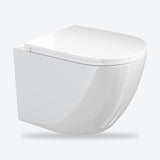
A wall-hung toilet is fixed to the wall and does not stand on the floor. Rimless means that the flushing rim running round under the edge of the ceramic, under which dirt can otherwise collect, is missing; our wall-hung toilets are rimless. Read more: Toilets.
Missing a term or not sure which part fits? Write to us via the contact page or browse all guides.
