
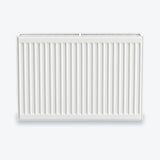



















A Type 22 radiator is sufficient for a heat pump if it still provides enough heat for the room at the lower flow temperature; it will fall well short of its familiar rating at 75/65/20 °C. At 55/45/20 °C, each of our valve-integrated panel radiators provides only around 51 per cent of that output; if heat is lacking, a longer or taller Type 22 or a Type 33 of the same dimensions can help.
Why does a radiator emit less heat with a heat pump?
A heat pump runs more economically the lower the flow temperature. For a radiator, the reverse applies: the greater the difference between the heating water and room air, the more heat it emits. As the water temperature falls, so does its output.
That is why we give two figures for every size. The first, 75/65/20 °C, means the heating water arrives at 75 °C, leaves the radiator at 65 °C, and the room is at 20 °C. This is the usual basis for conventional heating calculations. 55/45/20 °C represents operation at a low flow temperature, for example with a heat pump. Across all 62 sizes of our valve-integrated panel radiators, the second figure is around 51 per cent of the first.
Your system's actual flow temperature is determined by the heating curve. It is lower on mild days and higher on very cold days. The cold-day figure matters when choosing a radiator, and the installer determines it.
Type 22 and Type 33 at 55/45/20 °C
The table shows how much of the familiar output remains when the heating runs cooler.
| Size | Type 22, 75/65/20 | Type 22, 55/45/20 | Type 33, 75/65/20 | Type 33, 55/45/20 |
|---|---|---|---|---|
| 50 × 100 cm | 1,379 W | 710 W | 1,988 W | 1,024 W |
| 60 × 80 cm | 1,281 W | 660 W | 1,841 W | 948 W |
| 60 × 100 cm | 1,602 W | 824 W | 2,301 W | 1,184 W |
| 60 × 120 cm | 1,922 W | 989 W | 2,761 W | 1,421 W |
| 60 × 140 cm | 2,242 W | 1,154 W | 3,221 W | 1,658 W |
| 90 × 100 cm | 2,225 W | 1,145 W | 3,181 W | 1,637 W |
At 75/65/20 °C, a Type 22 measuring 60 × 100 cm provides 1,602 W; at 55/45/20 °C, only 824 W. A Type 33 of the same dimensions provides 1,184 W at a low flow temperature, around 44 per cent more than Type 22.
Three ways to get more heat at a low flow temperature
If a radiator is no longer sufficient, there are three variables: length, height and type. As a worked example, suppose the installer has calculated around 900 W for a room at 55/45/20 °C. The following are among the sizes in our range that could suit:
| Type and size | Depth | Output at 55/45/20 |
|---|---|---|
| Type 22, 60 × 120 cm | 104.3 mm | 989 W |
| Type 22, 50 × 140 cm | 104.3 mm | 994 W |
| Type 22, 40 × 180 cm | 104.3 mm | 1,059 W |
| Type 33, 60 × 80 cm | 160.3 mm | 948 W |
| Type 33, 50 × 100 cm | 160.3 mm | 1,024 W |
| Type 33, 90 × 60 cm | 160.3 mm | 982 W |
- Longer: The shallow Type 22 stays 104.3 mm deep and gains output through length. This suits spaces with plenty of wall but little depth available.
- Taller: Where the wall is narrow, height helps. A Type 33 measuring 90 × 60 cm needs only 60 cm of wall length.
- Deeper: At the same dimensions, Type 33 provides 43 to 45 per cent more output than Type 22, but is 160.3 rather than 104.3 mm deep.
The 900 W is only a worked example, not a recommendation for your room. Only a heat load calculation establishes how much heat it actually needs.
Do I need to replace all my radiators for a heat pump?
Not necessarily. The deciding factor in each room is whether the existing radiator emits enough heat at the future flow temperature. Where it does not, a larger radiator or a higher-output type is fitted in that room.
The existing heating system provides an initial indication. Gradually reducing the flow temperature on cold days shows which room stops getting warm first. That is the bottleneck. Agree such a test with your installer beforehand.
As a rough rule, the better the house is insulated, the more likely the existing radiators are to suffice. Poorly insulated rooms with large windows have higher demand and are the most likely to need a larger radiator. Only a heat load calculation gives a reliable figure for each room.
Does a heat pump need a special radiator?
No. A panel radiator works with any heat source; with a heat pump it simply needs to be large enough for the lower flow temperature. Suitability for a heat pump is therefore a matter of size rather than special construction. Radiators with built-in fans also exist, providing more heat at low temperatures; we do not stock those models.
To ensure every radiator receives the water flow it needs at low temperatures, the conversion includes hydraulic balancing. This, like mounting and connecting the radiators, is a job for the installer.
Frequently asked questions
Are output figures available for flow temperatures below 55 °C?
Not in our tables: we give the figures at 75/65/20 °C and 55/45/20 °C for every size. If the system runs cooler still, output falls further. The installer calculates how much for your system.
How big should a radiator be for 20 square metres with a heat pump?
Floor area alone cannot tell you: a room's heat requirement depends mainly on insulation and windows, while the necessary radiator size also depends on the flow temperature. Once the room's heat load is known, find a size reaching that figure in the 55/45/20 °C column of our wattage table.
Is Type 33 better than Type 22 for a heat pump?
It provides more output at the same dimensions but needs 56 mm more depth. A longer Type 22 can achieve the same: at 60 × 140 cm it provides 1,154 W at 55/45/20 °C, almost as much as a Type 33 at 60 × 100 cm with 1,184 W.
Suitable products and collection in Hagen
You can find both output figures for every size under Type 22 valve-integrated panel radiators and Type 33 valve-integrated panel radiators. For an overview of all radiators, see the Radiators collection. If you are converting several rooms, gather all the sizes into one enquiry; we will reply with the price, availability and collection date.
Collection by appointment from our warehouse – Im Mühlenwert 22, 58135 Hagen (rear entrance), Mon–Fri 8:30–17:30 and Sat 10–14. Advice in our shop – Eilper Straße 29, 58091 Hagen. Delivery by arrangement. More about the process under Collection and enquiries.