











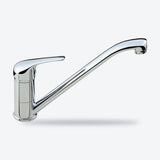







A thermostatic valve controls how much heating water flows into the radiator. Three things matter when buying: the design (angled or straight), the connection size and whether the valve has presetting. Here is how to identify these on your radiator, what presetting is for and which thermostatic head fits.
Valve, valve insert, thermostatic head: which is which?
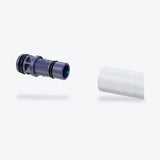
Two parts work together on the radiator. The valve sits in the water path and opens or closes the flow using a pin. The thermostatic head screws onto the valve: its sensor pushes the pin in or lets it out according to the room temperature.
Where the valve sits depends on the radiator:
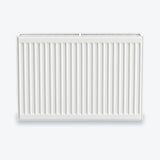
- Valve-integrated panel radiator: The valve sits as a valve insert inside the radiator itself. Our Type 22 and Type 33 valve-integrated panel radiators include the valve insert, which is not pre-fitted. The bottom connection uses an H-block valve; a thermostatic head is added for control.
- Radiator with side connection: Here the thermostatic valve sits externally at the radiator connection, with a radiator union on the other side. A thermostatic valve with presetting is intended for this arrangement.
If the pin sticks on a valve-integrated panel radiator or the radiator can no longer be controlled, the insert is often the cause. How to check this is explained in the guide Replacing a radiator valve insert.
Identifying angled and straight designs
The design depends on the direction from which the pipe approaches the radiator:
- Angled: The pipe meets the radiator connection at a right angle, for example when it comes up from the floor and the connection is on the radiator's side. The valve is angled.
- Straight: The pipe and radiator connection are in line, so the pipe approaches from the side. The valve is straight.
The easiest way is to look at the old valve: if it is angled, you need another angled valve; if it is straight, you need a straight one. A photo of the valve and pipe is enough for your enquiry. Our thermostatic valve with presetting is available in both designs, each in ½″.
Presetting: what it does and who adjusts it
Heating water takes the path of least resistance. Radiators near the pump therefore receive too much, and distant ones too little. Presetting limits the flow through each radiator to a fixed maximum, regardless of what the thermostatic head is doing. It is therefore the means of achieving hydraulic balancing.
You can see whether your existing valve can be preset underneath the thermostatic head: presettable valves have a scale on the valve body. Without it, the valve cannot be preset.
The correct value for each radiator comes from the installer's calculation, rather than a rule of thumb. The values depend on the valve, radiator and room. We therefore do not give settings here. Presetting is adjusted after installation, before the thermostatic head is fitted.
Thermostatic head: check the M30 × 1.5 thread
The thermostatic head must match the valve's thread. Our thermostatic head has the common M30 × 1.5 female connection thread, regulates at settings 1 to 5 and measures 48 mm in diameter by 79 mm in length. Only the head is supplied, without a valve insert.
For our thermostatic valve with presetting, the manufacturer specifies “thermostatic heads with a standard connection”. We confirm the exact thread with the quotation. It is therefore best to enquire about the valve and head together.
What the valve can withstand
Our thermostatic valve with presetting is designed for two-pipe heating systems with a normal temperature differential. The body, upper part and union are brass, the spindle is stainless steel and the seals are EPDM. According to the manufacturer, it withstands up to 120 °C and 10 bar.
Frequently asked questions
How do I know whether I need an angled or straight thermostatic valve?
Look at the old valve: if it is angled and the pipe meets the radiator at a right angle, you need the angled design. If the pipe and connection are in line, you need the straight design. Send us a photo if in doubt.
Will any thermostatic head fit my valve?
No. The head and valve must have the same connection thread. Our thermostatic head has M30 × 1.5. The valve or its rating plate shows whether your valve has this thread; for our thermostatic valve, we confirm the thread with the quotation.
How do I adjust a presettable thermostatic valve?
The presetting on the valve body is adjusted to a calculated value before the thermostatic head is fitted. The installer specifies this value during hydraulic balancing. Without that calculation, a correct value cannot be given.
Do I need to reset the presetting after replacement?
Yes. A new valve does not come out of the box with your setting. If the radiator has also been replaced, the old settings will usually no longer be suitable; the system must then be balanced again.
Do I need a separate thermostatic valve for a valve-integrated panel radiator?
On a valve-integrated panel radiator, the valve is provided as an insert inside the radiator. Our Type 22 and Type 33 models include the insert, which is not pre-fitted. An H-block valve for the bottom connection and a thermostatic head are also needed. The installer determines what else your system requires.
Matching products and collection in Hagen
Thermostatic valves, radiator unions in angled and straight designs and other valves are listed under Heating valves, while thermostatic heads and H-block valves are under Radiator accessories. How to connect a valve-integrated panel radiator at the bottom is explained in the guide Fitting an H-block valve.
Add the parts to the enquiry list and send your enquiry. We reply with price, availability and a collection date. The thermostatic valve is an order item. Collection is from the warehouse – Im Mühlenwert 22, 58135 Hagen (rear entrance), Mon–Fri 8:30–17:30 and Sat 10–14, by appointment. Advice is also available at the shop – Eilper Straße 29, 58091 Hagen. The process is described on the page Collection and enquiry. Installation and connection are carried out by a qualified installer.