














If a radiator gurgles or stays cold at the top while warming up at the bottom, it usually contains air. Air displaces heating water, so the surface no longer warms up fully. Bleeding takes only a few minutes per radiator and needs very few tools.
What you need
- a radiator bleed key (square), though a flat-blade screwdriver is enough for some valves
- a glass or small cup
- a cloth
Step by step
- Let the heating warm up, then switch off the circulation pump or let the heating rest briefly. This allows air to collect at the top of the radiator.
- Open the thermostatic head fully.
- Find the bleed valve. It sits at the top on the side, opposite the connection.
- Hold the glass underneath and open the valve slowly. Air hisses out first.
- Close it as soon as water flows without air bubbles. Do not unscrew it completely.
- For several radiators: start at the bottom of the house and work upwards.
- Check the pressure. After bleeding, the system has lost water. Compare the needle on the heating system's pressure gauge with the target value specified by your installer. If the pressure is too low, water must be topped up.
- Switch the pump back on.
If it does not help
If air keeps returning, something is wrong with the system, such as pressure loss or poorly adjusted hydraulic balancing. An installer can establish the cause. If the radiator remains cold at the bottom even after bleeding, deposits or the valve are more likely causes; a sticking valve pin can be checked after removing the thermostatic head.
How to recognise air in a radiator
Typical signs include gurgling or rushing noises when the heating starts and a radiator that stays cooler at the top than at the bottom. Air enters the system especially after filling, work on the pipework or replacement of a radiator. If only one radiator fails to warm up properly while the others heat, it is worth looking at that particular radiator first.
Where the bleed valve sits
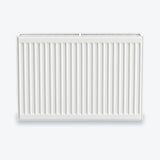
Air rises, so the bleed valve sits at an upper corner of the radiator. Valve-integrated panel radiators (bottom connection) with six connections, such as our Type 22 and Type 33, have a socket with a 1/2 inch female thread at the top and bottom on each side, plus two connections underneath. Which socket holds the bleed valve and which is closed with a blanking plug depends on the side to which the radiator is connected. The guide Bottom radiator connection: flow and return explains which connection is flow and which is return.
Several radiators in succession
With every radiator bled, the system loses some water and therefore pressure. Check the pressure gauge from time to time and have the water topped up before continuing. The correct pressure for your system is given in its documentation or by your installer.
Underfloor heating is bled differently
Underfloor heating has no bleed valves in the individual rooms. Bleeding takes place at the underfloor heating manifold, where all heating circuits meet; the manifold needs a bleed valve for this. The guide Bleeding underfloor heating describes the process.
New radiators
Our Type 22 and Type 33 valve-integrated panel radiators (bottom connection) are supplied with blanking and bleed plugs. After installation by an installer, the new radiator is bled in the same way during filling. Collect radiators, thermostatic heads and H-block valves from the warehouse at Im Mühlenwert 22 in Hagen, following an enquiry and by appointment.
If the radiator stays cold even after bleeding, work through the remaining causes in order: Radiator not heating up.
Our valve-integrated panel radiators (bottom connection) are available in heights of 40, 50, 60 and 90 cm and lengths from 40 to 200 cm. All available sizes, with dimensions and output, are listed in the guide Type 22 and Type 33 radiator dimensions; each size has its own page, for example Type 22 in 60 × 100 cm or Type 33 in 60 × 100 cm.
Frequently asked questions
Does the heating need to be off when bleeding?
The heating should have warmed up beforehand. To bleed it, switch off the circulation pump or let the heating rest briefly. Air then collects at the top of the radiator and escapes first when the valve is opened.
Which key do I need for bleeding?
Usually a square radiator bleed key. Some bleed valves have a slot, in which case a flat-blade screwdriver is sufficient. You also need a glass for the escaping water and a cloth.
Why does the radiator still not warm up after bleeding?
Then air is usually not the cause. Common causes include a sticking valve pin, insufficient system pressure or missing hydraulic balancing. Check the valve pin after unscrewing the thermostatic head; the guide Replacing a valve insert explains how to replace the insert.