




















Underfloor heating has no bleed valves in the floor: the pipes lie in the screed. Bleeding therefore takes place at the underfloor heating manifold, where all heating circuits meet. Here is how to recognise air, what must be fitted to the manifold, how bleeding works and when an installer should flush the circuits.
Signs of air in underfloor heating
Air displaces heating water. Where it collects, less water flows, or none at all. Typical signs:
- One area of the floor or an entire room stays cold while others become warm.
- There is gurgling or rushing at the manifold, as with a radiator containing air.
- The pressure on the system's pressure gauge has dropped.
Not every cold circuit contains air. If a circuit stays cold, a closed actuator or a system that has not been adjusted may also be the cause. More on this below.
What must be fitted to the manifold
The manifold needs an air vent valve for bleeding. You can check the manifold or its documentation to see whether yours has one. Our underfloor heating manifold can be extended with ball isolation valves, air vent valves and bypass valves; these parts are not included. Enquire about them together with the manifold.
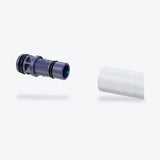
A connection set is available to isolate the flow and return at the manifold. Our manifold connection set consists of two ball valves, red for flow and blue for return, with a clip-on thermometer from 0 to 60 °C. The thermometer shows whether hot water is arriving.
Bleeding at the manifold: the procedure
Bleeding itself works in a similar way to a radiator:
- Hold a glass or cup and a cloth beneath the air vent valve.
- Open the valve slowly. Air comes out first, then water.
- Close it as soon as water flows without air bubbles.
- Compare the pressure on the system's gauge with the target value given by your installer. If water is missing, it must be topped up.
The guide How to bleed a radiator explains what to do with the pump during this process and how it looks on a radiator. The manufacturer's instructions also apply to your manifold.
Flushing circuit by circuit
If air is trapped in a long heating circuit, bleeding at the manifold is often insufficient. In that case, the circuits are flushed: water is passed through one circuit at a time while the others are closed. The reason is explained in the guide to hydraulic balancing: water follows the path of least resistance. If all circuits are open, it flows through the short heating circuits and leaves the air in the long ones.
Flushing involves opening and filling the system; afterwards, pressure and settings must be correct again. This is work for an installer.
Actuators: why a circuit can stay closed
In a controlled underfloor heating system, an actuator operates a heating circuit's valve controlled by the control system. NC means normally closed, NO normally open. An NC actuator without power therefore keeps its circuit closed, and no water flows through that circuit during either bleeding or flushing. Some models have a First-Open function for commissioning. Your actuator's documentation states whether it has this feature. More in the guide Underfloor heating actuator: NC and NO.
If the air keeps returning
If the system constantly needs bleeding and topping up, something is wrong with it. A faulty expansion vessel is one possible cause: the safety valve repeatedly opens, or pressure varies considerably during heating and cooling. The guide Heating system expansion vessel explains how to recognise this. An installer identifies the cause.
Frequently asked questions
Where do you bleed underfloor heating?
At the underfloor heating manifold. There are no bleed valves in the floor; the pipes lie in the screed. The manifold needs an air vent valve for this; it is available as an additional component for our manifold.
Does the pump need to be off when bleeding?
For radiators, the pump is switched off beforehand so that air can collect at the top. For the manifold, follow the manifold and system instructions. If in doubt, ask the installer.
How often does underfloor heating need bleeding?
Not at fixed intervals, but when signs of air appear. If air keeps returning, this indicates a system fault that an installer should investigate.
One circuit stays cold after bleeding. Why?
Check the actuator: an NC actuator without power keeps the circuit closed. If it is open, air may be trapped in the circuit; flushing by an installer can then help. If several circuits heat unevenly, the cause is more likely to be the system settings.
Parts and collection in Hagen
You can find underfloor heating manifolds, the connection set and manifold cabinets under Underfloor heating. Manifold and cabinet dimensions are in the guide Underfloor heating manifold: dimensions and cabinet. The manifold and connection set are order items: they are ready at the Hagen warehouse after the goods arrive, and we give you the collection date in our reply. Collection is from the warehouse – Im Mühlenwert 22, 58135 Hagen (rear entrance); advice is available in the shop – Eilper Straße 29, 58091 Hagen.