



















In short: If the water in the shower drains slowly or the drain smells, check the hair strainer and the odour trap first; the manufacturer Dallmer names clogged odour traps as a reason for slowly draining water. With shower channels and shower tray drains that have removable parts, you take off the cover, rinse the parts with warm water and put them back in according to the instructions. The consumer advice centres and the manufacturer Viega advise against chemical drain cleaners; for a blockage, the consumer advice centre of North Rhine-Westphalia names the plunger and the drain spiral as aids. Whether a spiral may be used in your drain is stated in its instructions.
What is inside the shower drain?
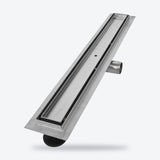
Under the grate or cover sits the odour trap, often also called a siphon. It prevents sewer gases from rising into the bathroom. Dallmer points out that it only seals tightly once it has clearly clicked into place after cleaning. Depending on the system, there is also a hair strainer that catches hair and coarse dirt; with TECE it is an accessory, with our drain sets for shower trays it is part of the scope of delivery.
| Part | Purpose | Care |
|---|---|---|
| Hair strainer | catches hair and coarse dirt | empty as soon as hair collects |
| Odour trap | holds back sewer gases | according to Dallmer, clean at least every 6 months |
| Grate or cover | covers the channel or the drain | according to TECE, soft cloth, warm water, mild household cleaner |
Cleaning the shower drain: step by step
Steps 1 and 3 to 5 follow the care instructions from Dallmer and TECE. For your drain, follow its own instructions.
- Remove the cover: lift out the grate, profile or tile tray with the tool supplied.
- Empty the hair strainer: if a hair strainer is fitted, remove hair and dirt and put them in the residual waste.
- Take out the odour trap: with Dallmer, reach in with your fingers, press it to one side and take it out; with TECE the part is called a dip tube and is taken out of the drain.
- Rinse: clean the parts in warm water and rinse the drain thoroughly. Dallmer recommends rubbing the seal with a little washing-up liquid.
- Put it back: with Dallmer, press the odour trap down evenly on both sides until it clearly clicks into place; with TECE, put the dip tube back in. Then insert the cover and let water run.
Do not loosen any permanently installed drain or sealing parts. Anything that cannot be removed by hand or with the tool supplied is not part of cleaning. For our shower channels and shower drains of the VS-DB01, VS-DB02 and VS-DB03 series we stock a stainless steel removal key as an accessory; which parts may be loosened with it is stated in the manufacturer's instructions.
Which cleaning agents are suitable?
For the cover and visible surfaces, TECE, Dallmer and Viega name warm water and mild cleaners; the odour trap and drain are rinsed out with water. For stainless steel, TECE advises against scouring sponges, hard objects, chlorine-based cleaners, bleach and strong acids. For chrome-plated shower tray drains and siphons, Dallmer advises against acidic cleaners, descalers and household vinegar.
| Agent | Suitable? | Source |
|---|---|---|
| Warm water, mild household cleaner, soft cloth | yes | TECE, Dallmer |
| Scouring sponge, steel wool, hard objects | no | TECE |
| Chlorine cleaner, bleach, strong acids (on stainless steel) | no | TECE |
| Vinegar, descaler, acidic cleaners on chrome-plated parts | no | Dallmer |
| Chemical drain cleaner | no | Viega, consumer advice centres |
| Hot water | not a cleaning agent; Viega allows it for its drains only briefly up to 95 °C | Viega |
Shower drain blocked: what to do?
First check the parts you can reach and clean the hair strainer and odour trap as described above. If the water still does not drain away, the consumer advice centre of North Rhine-Westphalia names two environmentally friendly aids that often help: the plunger and the drain spiral. TECE describes for its shower channel that access with a hand spiral by a tradesperson is possible. Check the instructions for your drain to see whether and how a spiral may be inserted.
The consumer advice centres warn against chemical drain cleaners: the aggressive chemicals do not always solve the problem, pollute the environment and can attack pipes and seals. Viega explicitly states for its drains that no chemical cleaning agents should be used against pipe blockages. If you get no further with plunger and spiral, professionals should take over; according to the consumer advice centre of North Rhine-Westphalia, deep-seated blockages can only be removed by a specialist company.
The shower drain smells: check the causes
- Deposits in the odour trap: they are a possible cause. Clean it as described above.
- Not inserted correctly: according to Dallmer, an odour trap that has not clearly clicked into place does not seal tightly, and sewer gases can escape.
- Rarely used shower: the drain can dry out. For its shower channel in rarely used showers, for example in holiday homes, TECE recommends a dip tube with an internal sealing membrane, which considerably extends the time until it dries out.
If it still smells even though the odour trap is clean and correctly inserted, have the drain checked by an installer.
Prevention: keeping the drain clear
- Use a hair strainer: the consumer advice centre of North Rhine-Westphalia recommends a drain strainer in the shower so that hair is not flushed into the pipe. TECE also recommends a hair strainer if hair frequently causes blockages.
- Clean the odour trap regularly, according to Dallmer at least every 6 months.
- Rinse off residues of shower gel, shampoo and hair dye with water; according to Dallmer they can attack the surfaces.
- Do not put solid waste into the drain or toilet; it blocks pipes.
- Look at the silicone joints around the shower channel and shower area regularly: TECE calls them maintenance joints that are checked for tightness and renewed if necessary.
Spare parts for shower channel and shower tray drain
For the shower channels and shower drains of the VS-DB01, VS-DB02 and VS-DB03 series we stock a plastic drain grate, and for the VS-DB01-Z01 siphon a rubber sealing ring. For shower trays with a 90 mm drain hole there are drain sets with an odour trap and hair strainer in the scope of delivery, for example the siphon set with chrome cover, the extra-flat drain set and the drain set without cover. Whether a part fits your existing drain, we clarify with your request, ideally with a photo.
If you are planning a new shower, the guide Choosing a shower channel helps; whether a shower tray or a shower channel suits you better is covered by Shower tray or shower channel. Terms such as shower channel and shower tray are explained in our glossary.
Frequently asked questions
How often should you clean the shower drain?
Empty the hair strainer as soon as hair collects. Dallmer recommends cleaning the odour trap at least every 6 months so that it does not clog and the water does not drain only slowly.
What to do with a blocked shower channel?
Remove the cover, take out the hair strainer and odour trap and clean them. If that does not help, the consumer advice centre of North Rhine-Westphalia names the plunger and drain spiral; whether a spiral may be inserted is stated in the channel's instructions. If the blockage remains, call in a specialist company.
Do home remedies such as vinegar or baking soda help?
For cleaning, the manufacturers name warm water and mild cleaners. Dallmer explicitly advises against household vinegar for chrome-plated drains and siphons and lists baking powder among the unsuitable agents for stainless steel surfaces. The manufacturers we checked say nothing about baking soda in the drain. For a blockage, the consumer advice centre of North Rhine-Westphalia names the plunger and drain spiral.
Can you pour boiling water down the drain?
For Viega drains, no: Viega allows hot water only briefly and up to a maximum of 95 °C, and boiling water is above that. For other drains, the manufacturer's information applies. Take care when handling hot water: there is a risk of scalding.
Why does the shower drain smell?
Possible reasons are deposits in the odour trap, an odour trap that has not clicked into place correctly and, in rarely used showers, a dried-out drain. If cleaning does not help, an installer should check the drain.
Request parts and collect in Hagen
Shower channels and shower drains can be found under Shower channels, spare parts under Shower channel accessories, drain sets for shower trays under Shower tray accessories. The parts are made to order: they are ready in the Hagen warehouse after goods receipt, and you will learn the collection date with our reply. Collection is at the warehouse – Im Mühlenwert 22, 58135 Hagen (rear entrance); advice is available in the shop – Eilper Straße 29, 58091 Hagen.
Sources and technical basis
- Dallmer: Cleaning and care instructions for building owners (German), retrieved on 17.11.2026
- TECE: Care instructions TECEdrainline shower channels and covers (German), retrieved on 17.11.2026
- Viega: Drains for bathtubs and shower trays (German), retrieved on 17.11.2026
- Consumer advice centre of North Rhine-Westphalia: Preventing pipe blockages (German), retrieved on 17.11.2026
- Federation of German Consumer Organisations: Do not dispose of waste in toilets and sinks (German), retrieved on 17.11.2026


